
The right time to start forehead Botox depends on what your forehead lines do, not on how old you are. The questions are whether the lines appear only when you raise your eyebrows, whether they linger after your face relaxes, and whether they are already there when your face is completely still. Starting does not commit you to treatment for life. The effect is temporary and wears off, so repeating it, leaving longer gaps or stopping are all decisions you can make later with your doctor. A three-step check in a mirror can show you which of those groups your lines fall into, but the decision itself belongs after an examination, because muscle strength, skin and the depth of the lines differ from one face to the next.
That is the short answer. The rest of this article explains what the treatment does to the forehead, what is and is not known about starting young, how to run the self-check, when Botox on its own may not be enough, and what happens at the appointment.
What forehead Botox actually does
"Botox" is the brand name most people know for botulinum toxin, and many use it for the whole group of products. A doctor injects small amounts into selected muscles, and the toxin temporarily reduces how strongly those muscles contract. When the muscle moves less, the skin over it is folded less.
On the forehead, the muscle in question is the frontalis. It is the muscle that lifts your eyebrows, and the horizontal lines across the forehead largely come from that movement. The US Food and Drug Administration (FDA) label for BOTOX Cosmetic lists, for adults, the temporary improvement in the appearance of moderate to severe forehead lines associated with frontalis muscle activity. Two phrases in that wording are worth noticing: "temporary" and "associated with frontalis muscle activity". The product is indicated for lines that come from movement, for a limited time.
The forehead is also a place where restraint matters. Because the frontalis lifts the brows, relaxing it too much can let the brows sit lower or feel heavy. The FDA label lists brow ptosis, a drooping of the brow, among the reported side effects, and it instructs that forehead lines be treated together with the frown lines between the brows to minimise that risk. In practice, forehead treatment is planned as a balance between the muscle that lifts the brows and the muscles that pull them down, not as a few injections placed wherever a line shows.
At Beauty Story, botulinum toxin is used for forehead, frown and eye lines, dosed conservatively for a natural look. The product, the injection sites and the plan are confirmed with you before treatment. That matters for a practical reason as well: the FDA label states that the units of one botulinum toxin product cannot be compared with the units of another, so a number quoted at one clinic does not translate directly to another product.
Is your twenties too early?
Age is the wrong measure. In a 2026 article from the American Society of Plastic Surgeons (ASPS), two member surgeons discussed what people call "preventative Botox", and one of them summed it up as much less about age and much more about what the face is doing. The other described treating patients in their late twenties who already have clear forehead creasing, because there is a visible finding and it bothers them. Both cautioned against treating a face with no lines at all, and one added that treating simply because social media says you should is not thoughtful medicine.

What about prevention? The idea is that if repeated movement gradually etches lines into the skin, softening that movement early might slow the process. Some surgeons consider early treatment reasonable for lines that are just beginning to set in. The evidence is less settled than the idea. The same ASPS article notes that there is no firm consensus among plastic surgeons on preventive use in younger patients. A 2025 systematic review in the journal Muscles described preventive use as promising but found the current evidence limited, with studies too varied in design, patient selection and outcome measures to define the right timing, dose or long-term effect. The authors called for long-term studies, including on whether early treatment could lead to tolerance or other changes over the years.
So the useful question is not "Am I old enough?" but "Do my lines show a pattern worth treating now?" For some people in their twenties the answer is yes. For some people in their thirties it is not yet. We have written separately about why starting earlier does not automatically mean staying ahead, in When Doing Nothing Is the Right Answer.
A three-step self-check you can do in a mirror
You can learn a lot about your forehead in two minutes. Stand in front of a mirror in even, natural light, with your hair pulled back from your forehead. Avoid looking up into a bright ceiling light, which throws shadows into every crease.
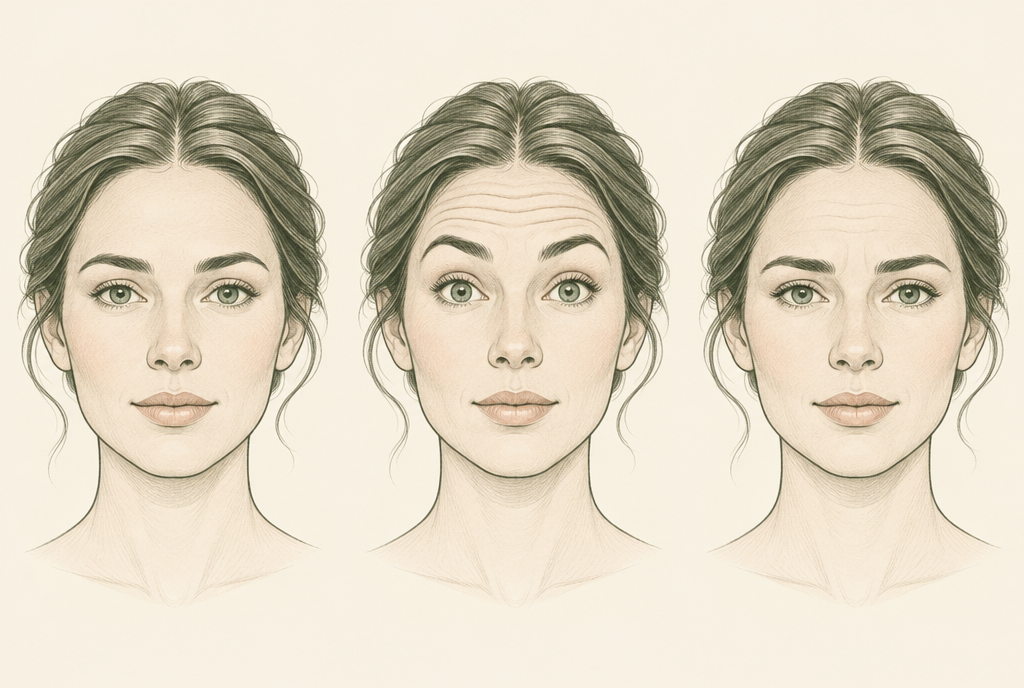
- Rest. Relax your face completely. Look straight ahead and check whether any horizontal lines are visible across your forehead.
- Raise. Lift your eyebrows as high as you can, as if surprised. Notice how many lines appear, how far across the forehead they run and how deep they look.
- Release. Let your eyebrows drop and keep watching. Do the lines disappear straight away, or do they stay for a few seconds before fading?
Swipe sideways to see the full table
| What you see | What it may suggest | What usually comes next |
|---|---|---|
| No lines at rest, lines only when you raise your brows, gone as soon as you release | Movement lines only. The skin is not holding a crease yet | Often nothing is needed yet. If the lines bother you, this is a reasonable stage to talk it through with a doctor |
| No clear lines at rest, but lines stay for a few seconds after you release | Lines are beginning to set in | Worth having assessed. One surgeon quoted by ASPS names lines that begin to linger as one of the signs she looks for |
| Lines visible even when your face is still | Lines are already etched into the skin | An examination is needed. Botox on its own may not be enough to soften them |
Treat the result as the start of a conversation, not a diagnosis. Light changes how lines look, so it helps to repeat the check on another day and in another room before drawing a conclusion. If you are planning a consultation, a short phone video of the three steps in good light is also useful to show the doctor.
When Botox alone may not be enough
Botox works on movement. It reduces the muscle activity that draws the crease, so it is aimed mainly at lines that come and go with expression. A line that stays when the face is completely still has become partly a feature of the skin itself. Relaxing the muscle means the skin is folded less often, but Beauty Story's doctors are clear that deep lines visible at rest may need other approaches alongside Botox, and that Botox by itself is not always sufficient. Which approaches depends on the examination, because muscle habits, skin elasticity and the depth of the lines differ from person to person.
It also helps to know what Botox does not do. The ASPS surgeons point out that changes such as deep folds or jowls come from tissue descending and loosening rather than from muscle movement, and Botox will not help with them. A forehead that looks heavy because the brows have dropped is a different problem from a forehead that creases when you talk. In the first case, relaxing the forehead muscle further can make the heaviness more noticeable, because that muscle is what holds the brows up. This is one of the reasons the treatment is planned after looking at you, not chosen from a menu.
Once you start, do you have to keep going?
No. Botox is a temporary treatment. The American Academy of Dermatology (AAD) describes the effect on lines and wrinkles as lasting about three to four months, and sometimes longer. As it wears off, the muscle gradually moves as it did before and the lines return. Nothing locks you in. You can repeat the treatment when the lines come back, leave a longer gap or stop.
Whether the gap between treatments can lengthen over time differs from person to person. The AAD notes that with repeat treatment for lines and wrinkles the muscle may thin, which can lead to longer-lasting results. That is a possibility, not a promise, and nobody can tell you in advance whether it will happen for you. Some people, once their lines have settled to a level they are comfortable with, choose to pause and see how their forehead changes before deciding again.
There is another side to this. One of the ASPS surgeons cautions that years of repeated treatment can lead to resistance to the medication and to thinning of the muscle, with a possible loss of normal expressiveness. The FDA label says that some studies suggest injections at more frequent intervals or at higher doses may lead to more antibody formation, and that this may be minimised by using the lowest effective dose at the longest feasible intervals. For BOTOX Cosmetic, it also notes that the safety and effectiveness of dosing more often than every three months have not been clinically evaluated. Taken together, these point toward a conservative approach: as little as works, as rarely as works, and a pause whenever the treatment is no longer answering a real concern.
Swipe sideways to see the full table
| Question | What the sources support | What you decide with your doctor |
|---|---|---|
| Do I have to continue for life? | No. The effect is temporary and wears off | Whether to repeat, wait longer or stop |
| Will the gap get longer? | The muscle may thin with repeat treatment, which can make results last longer (AAD) | Whether that happens for you, which cannot be promised |
| Does treating more often help? | For BOTOX Cosmetic, dosing more often than every three months has not been clinically evaluated, and more frequent or higher doses may increase antibody formation (FDA) | The interval and the amount |
What happens at the consultation and on the day
At Beauty Story, consultations are scheduled at one patient per hour, so there is time to watch how your forehead moves through different expressions. The doctor looks at how strongly the muscles move and whether the two sides move evenly, how elastic the skin is and how deep the lines are, including whether they appear only with expression or are already present at rest. You will be asked about previous toxin injections, medical conditions and any medicines you take. The product, the injection sites and the possibility of unwanted muscle weakness are explained before anything is done. If you are pregnant, breastfeeding or planning a pregnancy, tell the doctor at this point.

The AAD notes that the treatment can be done in a single office visit. Beauty Story's treatment information notes that bruising or tenderness at the injection points may occur, and that downtime is usually none to minimal but varies by individual. The AAD lists swelling, redness, soreness and bruising among the possible effects, a mild headache as uncommon, and a temporarily droopy brow or eyelid from weakness in a neighbouring muscle as rare. In the forehead-line clinical studies described in the FDA label for BOTOX Cosmetic, the reactions listed as most common were headache and brow ptosis.
Aftercare is short:
- Hands off. Do not rub or massage the injection sites, and if you apply makeup, avoid pressing it in.
- Exercise. The AAD advises waiting two hours before strenuous activity, including heavy lifting and workouts.
- Follow-up. Ask how and when the doctor would like to see the result, and who to contact if a brow or eyelid feels heavy.
Your doctor will confirm or adjust these instructions for you.
For visitors, timing is the part to plan. The AAD notes that most people see results within three to seven days, so the face you see as you leave the clinic is not the result. If you can, have the treatment early in your trip rather than the day before a flight home, so that you are still nearby if you want the doctor to see how it has settled.
Questions to ask before you book
How a clinic answers a few plain questions tells you more than the product name does.
- Do my lines come from movement, or are they already present at rest?
- How will you protect the position of my brows when you treat my forehead?
- Which product will you use, and why that one?
- If I decide not to continue, what happens to my forehead?
- Is now the right time, or would you wait?
A clear, specific answer to each is a good sign, and so is a doctor who is comfortable saying "not yet". If a clinic recommends treatment before anyone has examined you, our guide on how to avoid a conveyor-belt clinic in Korea explains what to check. Beauty Story is on the fifth floor of the KM Building at 562 Gangnam-daero, a minute's walk from Nonhyeon Station Exit 9, and offers English and Chinese-language consultation support.
Beauty Story Clinic (예쁜얼굴의원) is a slow-aging lifting clinic near Nonhyeon Station, Gangnam, led by a female doctor. This article was written from Beauty Story Clinic's published information and the doctors' explanations. It is general information, not a diagnosis or a treatment recommendation for any individual. Individual results vary.